the brief

Autonomy crept further into the defaults as Anthropic set Claude Code’s Auto Mode to on by default, while agent tooling matured with Shepherd’s fork/replay substrate. Infra thinking was front‑and‑center too—Red Hat’s CPU/GPU split for inference and ORCA’s calibrated reasoning savings—against a stark energy reality check from Amazon’s massive off‑grid gas plant for AI compute.

the poursit · sip · 10 items

pulse

(03)
  • simonw/blog· AnalysisAug 8, 10:36 PM

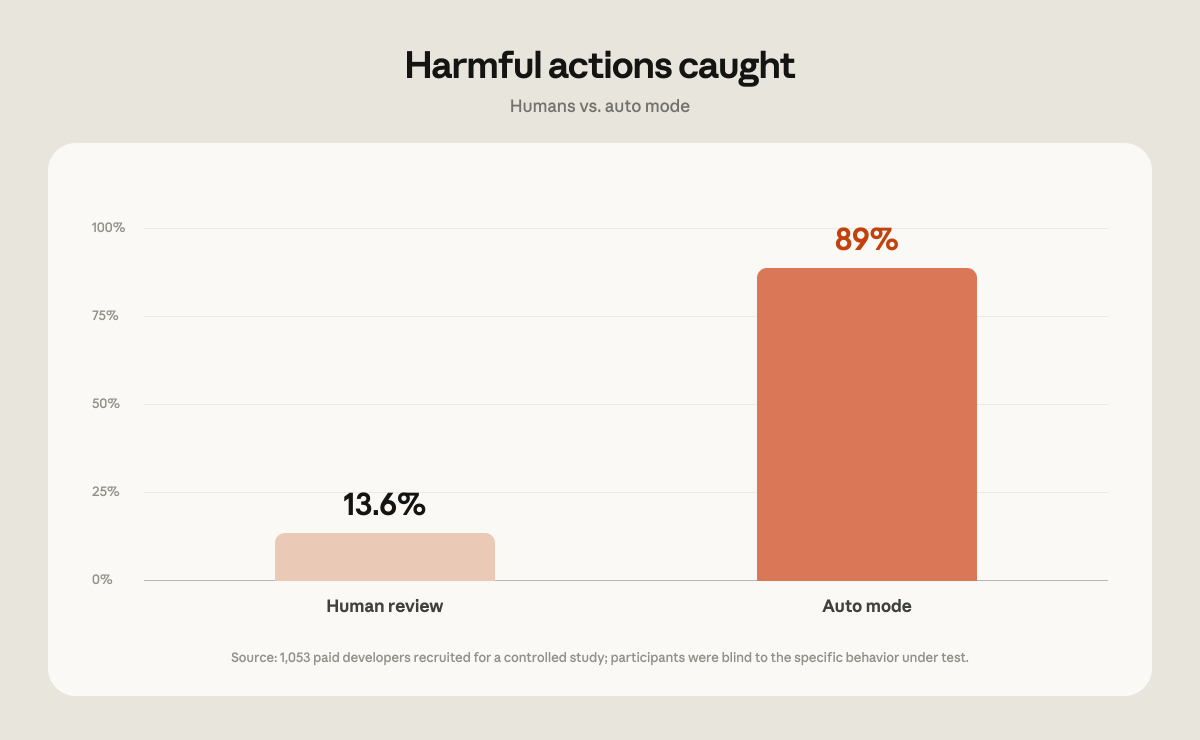
    Claude Code auto mode becomes default

    Anthropic will make Auto Mode the default for new Claude Code sessions on Pro, Max, and Team plans from Aug 14, signaling confidence in safer, more autonomous coding workflows.

    Auto mode is now the default in Claude Code for Pro, Max, and Team plans — <p><strong><a href="https://claude.com/blog/auto-mode-default-in-claude-code">Auto mode is now the default in Claude Code for Pro, Max, and Team plans</a></strong></p> Anthropic are <em>really</em> confident in Claude Code's <a href="https://code.claude.com/docs/en/auto-mode-config">auto mode</a>, to the point that they are making it the default setting for new sessions in most Claude Code plans starting on August 14th...

    signal 7hype 1claude_codeauto_modeproduct_updatelaunchsource ↗
  • marktechpost· AggregatorAug 8, 08:54 PM

    Shepherd runtime enables agent run forking

    Northeastern and Stanford released Shepherd, an MIT-licensed Python substrate that snapshots environment state so agents can fork, replay, and revert long runs, slashing token waste and easing debugging.

    Meet Shepherd: An Open-Source Python Substrate That Lets Meta-Agents Fork, Replay, and Revert Any Agent Run — Long agent runs accumulate state that no transcript records — edited files, a live dev server, installed packages, a warm prompt cache. When an agent misreads a traceback at step 10 and rewrites a correct file, patching forward burns tokens and restarting re-pays every call. Researchers at Northeastern University and Stanford University released Shepherd, an MIT-licensed Python runtim...

    signal 7hype 2agent_frameworkopen_sourcepythonlaunchsource ↗
  • techmeme· AggregatorAug 8, 03:45 PM

    Amazon backs 7.65 GW gas plant

    Amazon is financing an off-grid Texas gas plant to power a massive AI data center, potentially the largest single US emitter, underscoring AI’s escalating energy demands versus net‑zero goals.

    Amazon is backing a 7.65 GW gas plant for an off-grid TX AI data center, potentially the largest single US emissions source, at odds with its 2040 net-zero goal (Hiroko Tabuchi/New York Times) — Hiroko Tabuchi / New York Times: Amazon is backing a 7.65 GW gas plant for an off-grid TX AI data center, potentially the largest single US emissions source, at odds with its 2040 net-zero goal — The tech giant is investing in the natural-gas-burning power plant as part of a huge data center in Texas,...

    signal 6hype 2ai_infrastructureenergydata_centersculturalsource ↗

findings

(04)
  • dtemkin.bsky.social· BlueskyAug 8, 07:03 PM

    LLMs driving code style monoculture

    New study documents how LLM suggestions propagate uniform patterns—like defaulting to random seed 42—raising concerns about homogenized idioms, hidden coupling, and security fragility across codebases.

    This piece asks if LLMs are moving us toward a monoculture of code style; pic shows how it's spread the use of 42 as random seed number. arxiv.org/pdf/2607.13077

    Chart showing how use of the number 42 as random number seed ramps up alongside ChatGPT
    signal 4hype 1llmcode_stylearxiv_paperculturalsource ↗
  • ai-firehose.column.social· BlueskyAug 8, 12:10 PM

    ORCA slashes reasoning cost via calibration

    ORCA dynamically calibrates when a model should “think” using meta-learning and conformal prediction, reporting 67% compute savings with comparable accuracy, a promising recipe for cheaper chain‑of‑thought.

    Online Reasoning Calibration (ORCA) boosts large language model efficiency by dynamically calibrating confidence during reasoning, achieving 67% savings while maintaining accuracy. This new method merges meta-learning and conformal prediction for better performance. https://arxiv.org/abs/2604.01170

    signal 6hype 2research_paperreasoningefficiencytechnicalsource ↗
  • hn/frontpage· AggregatorAug 8, 12:16 PM

    Rebalancing CPU/GPU for LLM inference

    Red Hat argues shifting memory-bound and prefill stages to CPUs can reduce costs and improve portability, prompting fresh designs for mixed CPU‑GPU serving stacks in enterprise environments.

    The CPU is back: Rethinking the CPU-GPU split for LLM inference — Article URL: https://www.redhat.com/en/blog/cpu-back-rethinking-cpu-gpu-split-llm-inference Comments URL: https://news.ycombinator.com/item?id=49221089 Points: 7 # Comments: 0

    signal 6hype 3inferencecpu_gpu_splitcpu_offloadtechnicalsource ↗
  • nber.org· BlueskyAug 8, 03:02 PM

    H‑1B expansion boosted US productivity

    An NBER paper finds expanding high‑skilled immigration raised US wages and productivity, including in non‑STEM roles via supply chains—useful context for AI hiring, clusters, and policy debates.

    Expanding H-1B visas boosted US worker incomes and productivity, especially in non-STEM jobs, with gains flowing downstream via supply chains, from Ran Abramitzky, Leah Platt Boustan, Ahmet Gulek, and Jens Hainmueller www.nber.org/papers/w35560

    signal 5hype 1immigration_policylabor_economicsresearch_paperculturalsource ↗

voices

(03)
  • simonw/blog· AnalysisAug 8, 02:06 PM

    Simon Willison on OpenAI–HF timeline

    Willison highlights a subtle timeline detail in the accidental OpenAI–Hugging Face incident, raising questions about automated training-run behavior, governance, and disclosure practices.

    Now we have a timeline of the OpenAI accidental attack against Hugging Face — <p><a href="https://news.ycombinator.com/item?id=49220609#49221745">My comment</a> on <a href="https://news.ycombinator.com/item?id=49220609">Now we have a timeline of the OpenAI accidental attack against Hugging Face</a> &mdash; Hacker News.</p><p>I think one of the most interesting details here might be tucked away in that first bulletin point:</p> <blockquote> <p>May 7: OpenAI starts a new training run for an exp...

    signal 6hype 2incident_timelineopenaihugging_faceculturalsource ↗
  • thezvi/vase· AnalysisAug 8, 04:02 PM

    The Zvi’s synopsis of OpenAI–HF fallout

    Zvi offers a compact narrative of the event and implications, a useful primer for operational guardrails, rate‑limiting, and organizational responsibility in automated systems at scale.

    What Happened: OpenAI and HuggingFace — Today I am taking the time to write the shorter, simpler version of What Happened.

    signal 5hype 3openaihugging_faceindustry_analysisculturalsource ↗
  • melaniemitchell.bsky.social· BlueskyAug 9, 01:01 AM

    Melanie Mitchell resurfaces prescient paper

    Mitchell points back to a 2025 paper coauthored with Hugging Face colleagues, framing present failures through earlier findings on model behavior and evaluation blind spots.

    Worth revisiting this prescient paper from @mmitchell.bsky.social and others from @hf.co : arxiv.org/abs/2502.02649

    signal 5hype 2arxivpaperresearchtechnicalsource ↗
Today's Cuppa · Cuppa